A clean reading from a cheap, basic detector doesn't mean a clean room. It usually means the detector didn't catch anything that was transmitting at that exact moment. That is why most amateur sweeps fail.
This is a look at what a "bug" is actually engineered to do today, why a lot of first sweeps miss it entirely, and what a real bug detector, from the simplest handheld unit to a full sweep kit, can do to make sure you find all threats.
Check out our guide to the high-end TSCM equipment we keep in stock, all ready to ship the same day, or browse our guide to the full NLJD range and find the right model for your sweep.
What a "Bug" Is Actually Built to Do
Most people's picture is a tiny microphone constantly recording audio somewhere, and a person constantly listening on the other side. Some do exactly that, but a lot don't, so that is what needs to be addressed first.
Professional-grade listening devices generally fall into three categories:
01
Standalone Recorders
Store audio locally on internal memory and never transmit anything. No SIM, no Wi-Fi, no RF signature of any kind. A detector built to catch a broadcast signal has nothing to catch, because nothing is being broadcast.
02
GSM and 4G Bugs
Sit completely silent until called. Insert a SIM, hide the device, and it stays silent, with no activity until someone dials its number and it answers. Sweep the room a minute before that call, and you'll find nothing, because there's genuinely nothing there to find yet.
03
Wi-Fi Bugs
Connect to a network and stream audio, but many only activate on voice detection, meaning long periods of silence between transmissions that a detector also can't detect.
We've written a full breakdown of how each of these actually works, with real device examples, in our guide to GSM bugs and listening devices. It's worth reading if you want to understand the threat and how they work.
Why a DIY Sweep Can Fail
We always answer the same assumption from our customers, that any bug detector will catch any bug. Here are three places a basic bug detector can't see and can easily fail to detect.
01
The Bug That Never Transmits
A passive standalone recorder emits zero RF, ever. No detector that relies on picking up a signal will find it. The only category of tool built for this is a
non-linear junction detector, which locates electronic components by their semiconductor response rather than by catching a broadcast.
02
The Bug Is Hiding in the Noise
A room full of legitimate signals like your own Wi-Fi router, a Bluetooth speaker, and a neighbor's phone creates cover for anything trying not to be noticed. A basic detector that alarms on any signal above a threshold will either miss a weak, disguised transmission buried in that noise, or it'll emit sound so often on harmless traffic that you stop trusting it. This is where digital signal processing matters, so a detector like the
Protect 1207i is built specifically to tell a real threat apart from routine RF clutter, rather than just reacting to the loudest signal in the room.
03
The Threat That Isn't a Bug at All
Audio and video are usually discussed together, but they need different detection methods. A hidden camera saving to a local SD card, exactly like a passive audio recorder, transmits nothing and won't trip an RF-based bug detector. That's a job for an, which finds the camera's reflection rather than its signal, something we cover in detail in our
comparison of optical detectors.
What a Real Bug Detector Needs to Do
None of this means you need every category of equipment. It means matching the tool to the specific situation you're worried about.
If you're looking for an entry-level RF detector, the Protect 1207i covers the m
ost common scenario: a bug that's actively transmitting somewhere in the room. It's the right first purchase for most people checking a home, office, or rental for the first time.
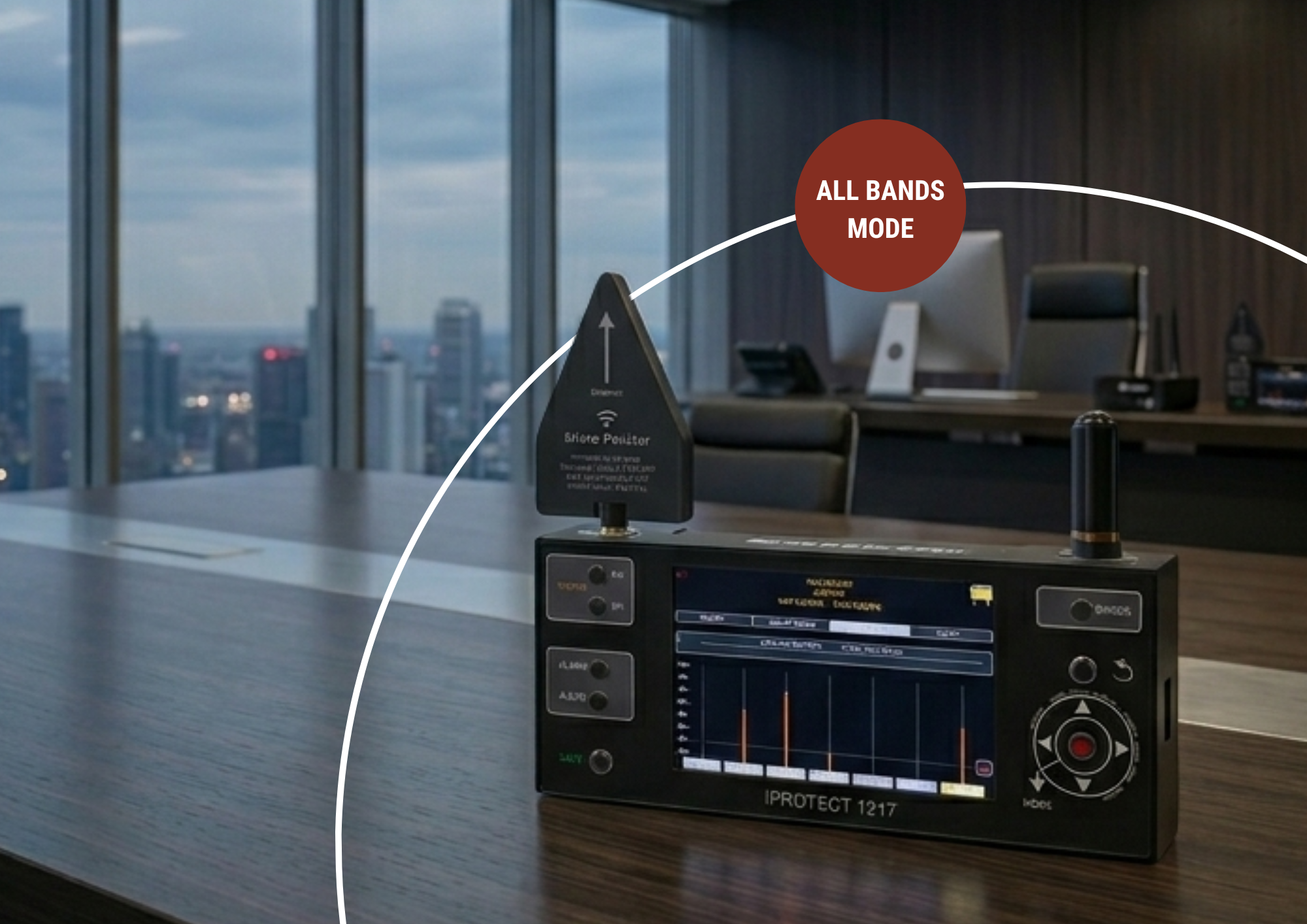
An upgrade is usually either the iProtect 1216 with three bands up to 12 GHz, which matters because newer covert devices increasingly operate above 5.8 GHz, a range that a lot of cheap detectors simply can't see. If a GPS tracker is part of the concern, the iProtect 1217 adds a dedicated GPS Tracker mode built for vehicle sweeps.
If you're worried about something that might be switched off, hardwired, or simply never transmits, that's a different tool like the EDD-24T. This is usually the second thing a serious buyer adds, not the first, because it answers a more specific and higher-stakes question.
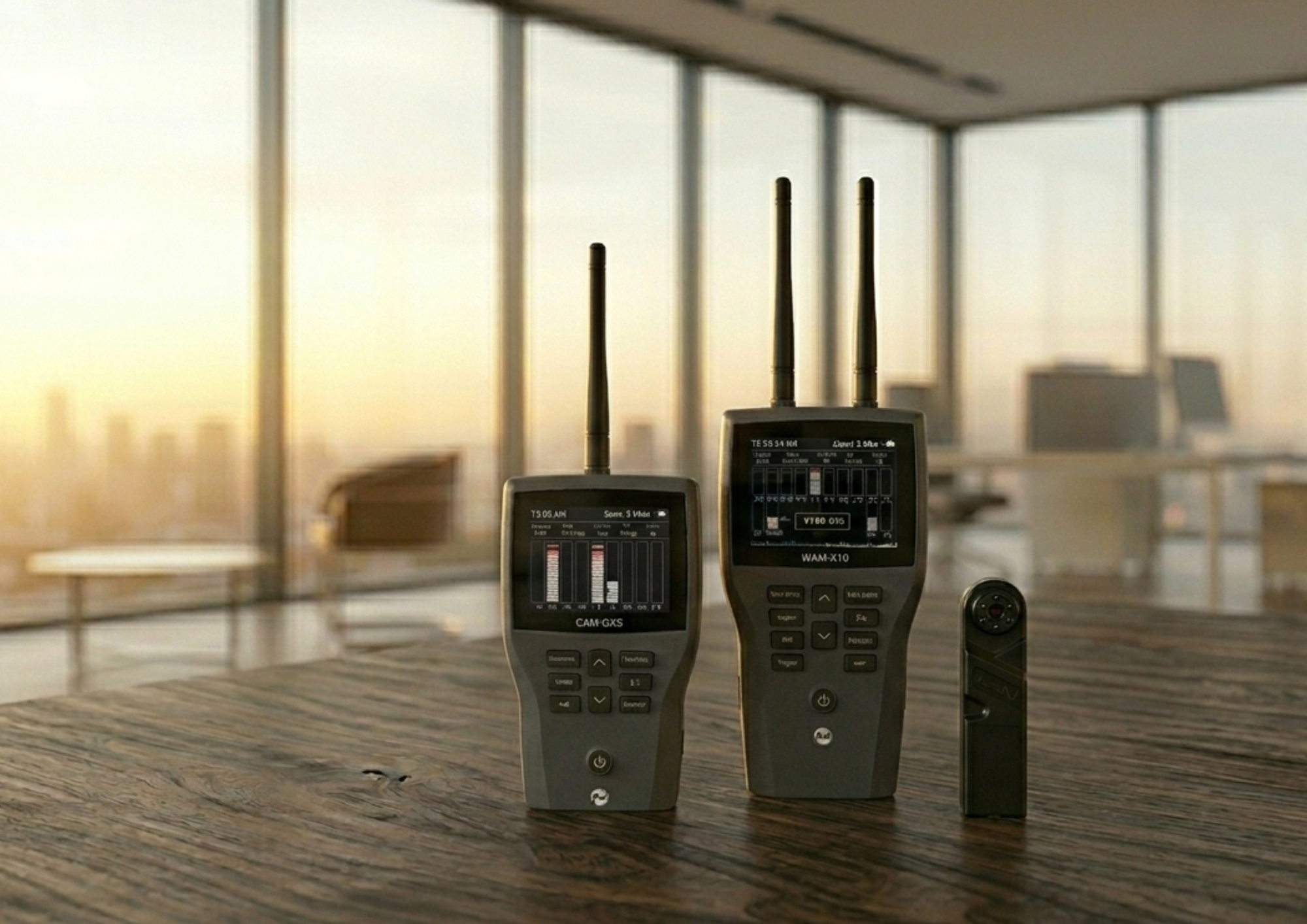
For anything cellular, a phone, a GSM bug, a 5G-connected camera, the CAM-GX5 and WAM-X10 will be user-friendly but professional options, and both pair naturally with the WEGA-i for an optical check in the same pass. They're available on their own or as part of a kit: a pre-built sweep kit bundle that professionals actually carry together.
A Simple Way to Test Whether Your Bug Detector Is Actually Working
Before you trust a clean reading, it helps to know your detector is behaving correctly in the first place.
Walk the room once with your own Wi-Fi router and phone active, and note what the detector picks up; that's your starting point for "normal" signals. Then walk it again with your router unplugged and your phone in another room. If the readings barely change, or the device alarms constantly regardless of what's actually transmitting, it's not distinguishing signals, it's just reacting to noise, and a real threat could be sitting inside that noise undetected.
Frequently Asked Questions
What does a bug detector actually detect?
A standard bug detector picks up active radio-frequency transmissions - the signal a listening device sends out while it's operating. It cannot detect a device that isn't transmitting at the moment you scan, regardless of price.
Can a bug detector find a bug that's switched off?
No. RF detectors, by design, only find active signals. A device that's dormant, hardwired, or deliberately silent needs a
non-linear junction detector, which locates it by its electronic components rather than a broadcast.
Is a cheap bug detector good enough?
It depends on what you're checking for. A basic detector can detect an obvious, continuously transmitting device. It generally can't distinguish a real threat from routine Wi-Fi and Bluetooth clutter, and it won't catch anything that isn't actively broadcasting, which is a growing share of what's actually out there.
Do I need a separate detector for hidden cameras?
If the camera transmits over Wi-Fi or Bluetooth, an RF detector can catch it. If it saves locally to an SD card, it emits nothing, and only an
optical lens detector will find it. A full sweep typically uses both.
How do professionals check for bugs that a basic detector would miss?
A trained sweep layers method rather than relying on a single device: an optical pass for camera lenses, an RF scan of the full room, a hands-on search, and a non-linear junction pass for anything silent. Each step covers a gap that the others leave open.
How much does a real bug detector cost?
It ranges widely by category. Entry-level RF detectors built for genuine threat discrimination start under €700, while professional wideband and cellular-specific units run considerably higher. Non-linear junction detectors and full sweep kits sit at the upper end of that range.
Get in touch with our team, and we'll help you match a budget to your actual concern.
Counter-surveillance equipment is legal to purchase and use across the EU, UK, and most jurisdictions globally, provided it is used for lawful defensive purposes. SpyShopEurope operates in full compliance with relevant EU and international regulations.
Continue exploring
Want to go deeper into counter-surveillance?
Browse the full Counter Surveillance range or read more about the latest on the blog. Not sure which detector fits your situation?
Contact our team for help.


 Order until 13:00 CET and we will ship today! One-day delivery across EU and UK